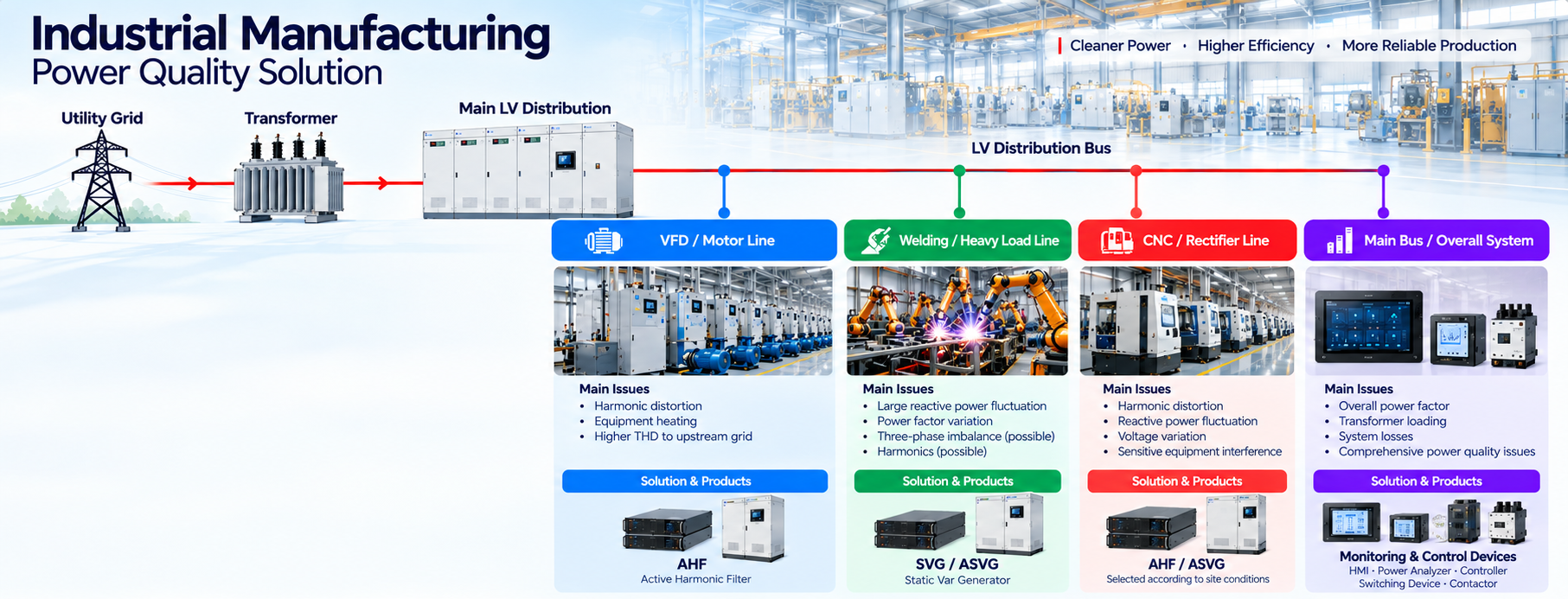
Industrial manufacturing facilities rely on motors, variable frequency drives, welding equipment, rectifiers, CNC machines, pumps, fans and automated production systems.
These mixed electrical loads create continuously changing operating conditions. Poor power quality can increase electrical losses, reduce equipment reliability and affect production continuity.
Power Quality Problems
Harmonic DistortionVFDs, rectifiers, welding machines and other power electronic loads can generate harmonic currents that affect transformers, cables and sensitive equipment.
Low Power FactorMotors and other inductive loads consume reactive power, increasing system current and reducing electrical system efficiency.
Rapid Reactive Power FluctuationWelding machines, cranes, large motors and frequently changing production loads can cause reactive power and power factor to fluctuate rapidly.
Three-Phase ImbalanceUneven single-phase loads or unbalanced production equipment may create current and voltage imbalance between phases.
Voltage FluctuationLarge motors, welding equipment and rapidly changing loads can cause voltage variations and affect nearby equipment.
Capacitor Failure & ResonanceConventional capacitor banks operating in harmonic environments may experience overheating, overcurrent or harmonic resonance.
Power Quality Challenges
Mixed Load CharacteristicsDifferent production lines may contain motors, VFDs, rectifiers and other nonlinear loads at the same time, making the power quality environment more complex.
Frequent Load ChangesProduction equipment starts, stops and changes operating power frequently, causing continuous variation in current and reactive power demand.
High Production Continuity RequirementsElectrical disturbances may cause equipment trips, control failures or production interruptions, making system reliability especially important.
Existing Electrical SystemsMany factories already have capacitor banks or older compensation systems, so new equipment must be coordinated with the existing distribution system.
Distributed Disturbance SourcesPower quality problems may originate from different workshops or production lines, requiring both centralized and local treatment strategies.
Power Quality Solution
Harmonics from VFDs & Nonlinear LoadsMeasure harmonic distortion at major production loads, workshop distribution boards and the main LV bus to identify the primary harmonic sources. Where harmonic current is significant, AHF can be installed close to major nonlinear loads or at the main distribution bus to prevent harmonic currents from propagating through the electrical system.
Low Power Factor & Reactive Power DemandFor relatively stable inductive loads such as motors, power capacitors or intelligent capacitor compensation can provide economical base reactive power compensation. Where reactive power changes rapidly, SVG can provide dynamic compensation and maintain a more stable power factor.
Capacitor Compensation in Harmonic EnvironmentsBefore adding capacitor compensation, harmonic levels and resonance risk should be evaluated. Where harmonics are present, power capacitors with reactors, anti-harmonic intelligent capacitors or detuned compensation systems can be used to reduce harmonic amplification and protect capacitor branches.
Multiple Power Quality ProblemsWhere harmonics, reactive power and three-phase imbalance occur simultaneously, ASVG or a coordinated combination of AHF, SVG and capacitor compensation can be selected according to actual site conditions.
Monitoring & Coordinated ControlControllers, power quality monitoring devices and switching equipment can coordinate capacitor compensation branches and monitor power factor, reactive power, harmonic conditions and operating status.
Recommended System Architecture
Main Power Path
Utility Grid → Transformer → Main LV Distribution → Workshop Distribution → Production Loads
Typical production loads may include:
VFD / Motor Drives · Welding Equipment · CNC Machines · Pumps & Fans · Rectifier Loads · Automation Systems
Recommended Treatment Points
Major Nonlinear LoadsMain concern: Harmonic Current
Recommended approach: Local harmonic measurement and AHF compensation close to major VFD, rectifier or welding loads where required.
Workshop Distribution BusMain concern: Harmonics · Reactive Power · Load Imbalance
Recommended approach: AHF, SVG or ASVG according to the dominant power quality problem.
Capacitor Compensation BranchMain concern: Base Reactive Power Demand · Harmonic Resonance
Recommended approach: Capacitors with appropriate reactors, controllers and switching devices.
Main LV DistributionMain concern: Overall Power Factor · Transformer Loading · System Losses
Recommended approach: Centralized compensation and coordinated power quality management.
Main Monitoring PointMain concern: Overall System Performance
Recommended monitoring: THD · Power Factor · Reactive Power · Voltage · Current Imbalance
Power quality treatment can be applied at the load level, workshop level or main distribution level according to the location and severity of the disturbance.
Final equipment configuration should be determined according to actual load characteristics, harmonic measurements, reactive power demand and existing compensation equipment.
Case Studies
Proven in Real Projects
Selected field projects where this solution has been applied. Click any card to see the full case with measured results.
• Product or model
• Application or problem to solve
• Required specifications, such as voltage, frequency or capacity
• Quantity and delivery requirements
You can also attach drawings, product photos or test reports, if available.