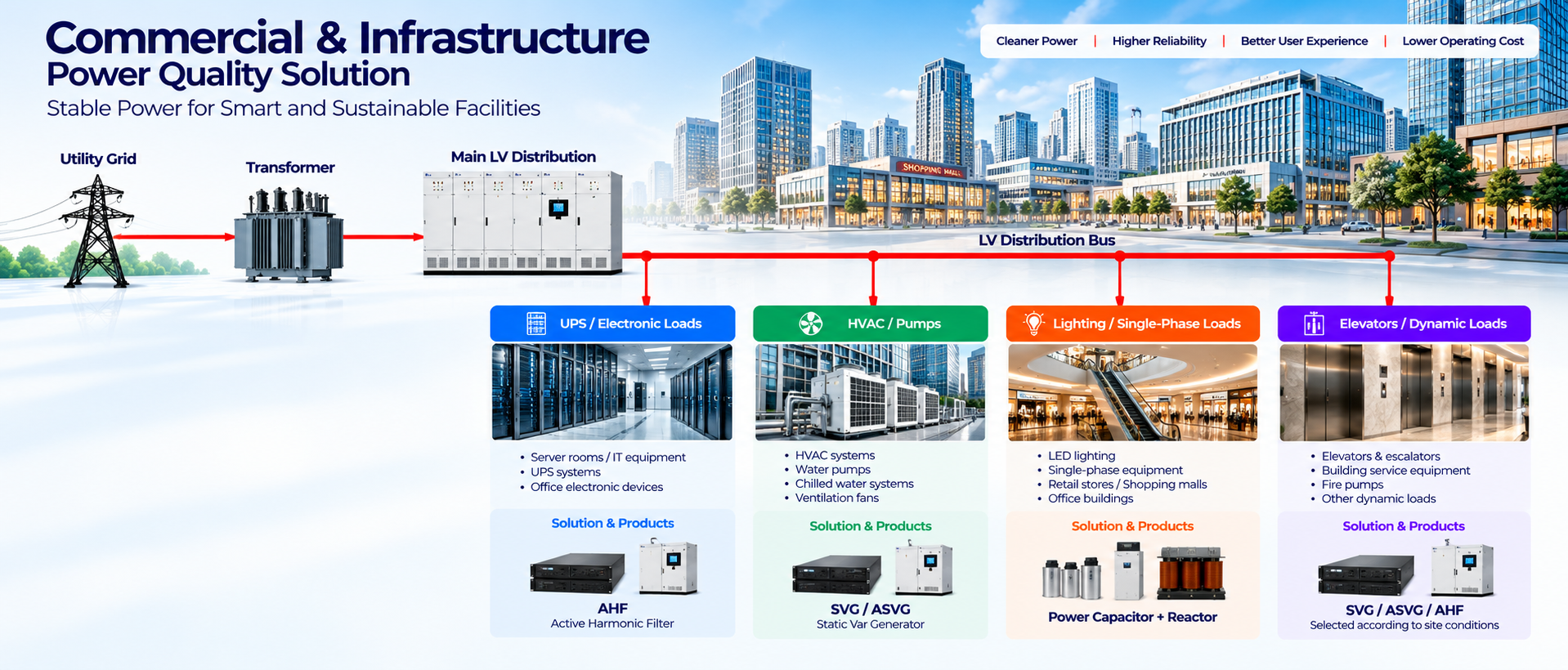
Commercial & Infrastructure Power Quality Solution
Industry Overview
Commercial buildings and public infrastructure rely on a wide range of electrical loads, including HVAC systems, elevators, pumps, UPS systems, LED lighting, office equipment and other electronic devices.
As these loads become increasingly power-electronic and distributed, maintaining stable power factor, low harmonic distortion and balanced three-phase operation is important for reducing electrical losses and improving distribution reliability.
Power Quality Problems
Harmonic DistortionUPS systems, LED drivers, VFD-driven HVAC equipment, elevators and other nonlinear loads can generate harmonic currents throughout the building distribution system.
High Neutral CurrentLarge numbers of single-phase electronic loads may produce triplen harmonics that accumulate in the neutral conductor, increasing thermal stress.
Low Power FactorMotors, pumps, HVAC equipment and other inductive loads consume reactive power, increasing current and reducing distribution efficiency.
Three-Phase ImbalanceUneven distribution of single-phase loads across phases can cause current imbalance, neutral current and additional system losses.
Reactive Power FluctuationElevators, pumps, HVAC systems and other intermittently operated equipment can cause reactive power and power factor to vary during operation.
Transformer & Cable HeatingHarmonics, imbalance and excessive current can increase losses and temperature in transformers, cables and distribution equipment.
Power Quality Challenges
Diverse Load TypesCommercial and infrastructure systems combine lighting, HVAC, UPS, elevators, pumps and electronic loads with very different electrical characteristics.
Distributed Disturbance SourcesPower quality problems may originate from multiple floors, zones or subsystems, making it difficult to rely on a single centralized treatment point.
Highly Variable Operating ConditionsBuilding occupancy, HVAC demand, pump operation and elevator usage change throughout the day, causing continuous variation in electrical load.
Existing Compensation SystemsMany facilities already have capacitor banks or conventional power factor correction systems that may need to be evaluated before upgrades.
Reliability & Safety RequirementsElectrical disturbances may affect building services, communication systems, sensitive electronic equipment and critical public infrastructure.
Power Quality Solution
Harmonics from UPS, LED & VFD LoadsMeasure harmonic distortion at major nonlinear loads, floor distribution panels and the main LV bus to identify where harmonics are concentrated. Where harmonic current is significant, AHF can be installed near major disturbance sources or at a common distribution bus to reduce harmonics before they propagate upstream.
Low Power Factor & Stable Reactive Power DemandFor HVAC motors, pumps and other relatively stable inductive loads, power capacitors or intelligent capacitor compensation can provide economical reactive power compensation. Where harmonic levels are significant, reactors or anti-harmonic capacitor solutions should be considered to reduce resonance risk.
Dynamic Reactive Power & Load VariationWhere reactive power changes frequently due to elevators, pumps or HVAC operation, SVG can provide faster dynamic compensation and help stabilize power factor. Where reactive power, harmonics and three-phase imbalance occur simultaneously, ASVG can be considered according to actual system conditions.
Three-Phase Imbalance & Neutral CurrentSingle-phase loads should first be evaluated for phase distribution and harmonic content. Where imbalance and harmonic current are both present, active compensation can be applied at the relevant distribution level to reduce phase current imbalance and excessive neutral current.
Monitoring & Automatic ControlAt the main distribution or compensation system level, power quality monitoring instruments, compensation controllers, HMI, switching devices and capacitor-duty contactors can support real-time monitoring and automatic compensation control.
Recommended System Architecture
Main Power Path
Utility Grid → Transformer → Main LV Distribution → Building / Infrastructure Distribution Bus
Typical branches may include:
HVAC / Pump Systems
UPS / IT / Electronic Loads
Lighting / Single-Phase Loads
Elevators / Other Dynamic Loads
Recommended Treatment Points
UPS / Electronic Load BranchMain concern: Harmonics · Neutral Current
Recommended approach: Local or centralized AHF according to harmonic concentration.
HVAC / Pump BranchMain concern: Reactive Power · Low Power Factor · VFD Harmonics
Recommended approach: Capacitor-based compensation for stable reactive demand; AHF or dynamic compensation where required.
Lighting / Single-Phase Load BranchMain concern: Harmonics · Three-Phase Imbalance · Neutral Current
Recommended approach: Load balancing and active compensation according to measured conditions.
Elevator / Dynamic Load BranchMain concern: Reactive Power Fluctuation · Harmonics · Load Variation
Recommended approach: SVG, ASVG or AHF according to the dominant problem.
Main LV DistributionMain concern: Overall Power Factor · THD · Imbalance · Transformer Loading
Recommended approach: Centralized monitoring and coordinated compensation.
Final equipment configuration should be based on actual harmonic levels, reactive power demand, phase imbalance, existing compensation equipment and facility operating conditions.
Case Studies
Proven in Real Projects
Selected field projects where this solution has been applied. Click any card to see the full case with measured results.
• Product or model
• Application or problem to solve
• Required specifications, such as voltage, frequency or capacity
• Quantity and delivery requirements
You can also attach drawings, product photos or test reports, if available.