SiC Ultra-High Efficiency
99% peak efficiency with silicon carbide MOSFETs

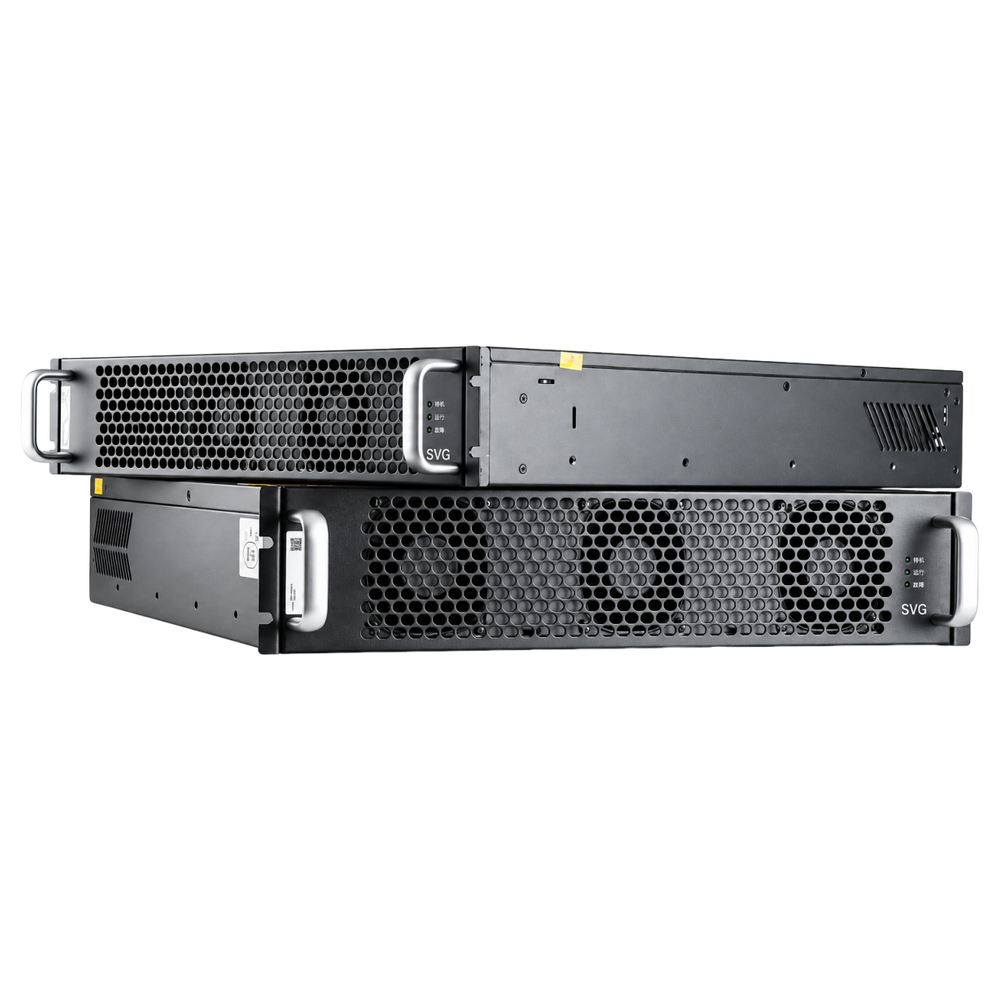
SiC Series
Static Var Generator
High-efficiency reactive-power control, engineered for modern electrical systems.
Product Advantages
leenhoo SiC SVG applies silicon carbide power devices to improve conversion efficiency, thermal performance and integration.
The system provides real-time reactive-power and three-phase unbalance compensation across a flexible modular platform.
Silicon carbide (SiC) MOSFETs enable higher switching frequency, lower losses and a compact thermal design.
Silicon carbide (SiC) MOSFETs achieve ultra-high efficiency through a wide bandgap, lower on-state resistance, faster switching and reduced switching losses. These properties support higher operating frequencies and temperatures with improved overall performance.
Higher conversion efficiency reduces internal operating loss.
Energy savings accumulate over continuous operation.
For a 400 V / 100 kVAr SVG, the brochure’s efficiency illustration shows more than 18,890 kWh and more than 2,834 USD per year. This is an illustration, not a site-specific reference.
99% peak efficiency with silicon carbide MOSFETs
Fast response <50 µs, full response <15 ms
Up to 800 kVAr in one cabinet
30K, 50K, 75K, 100K and 200K ratings, unlimited parallel
Wall-adjacent installation with configurable size, capacity and IP class
Improved resistance to corrosion and conductive dust
AHF handles harmonics while SVG compensates reactive power
Wall-mounted, rack-mounted and cabinet configurations
UPS and PDU reactive-power support
Stable power factor for precision process loads
Welding and rectifier reactive compensation
Furnace and mill reactive-power control
Pump and process-drive reactive and unbalance compensation
HVAC, lighting and transformer power-factor correction
Imaging and critical-load power-factor support
Traction and station reactive compensation
Inverter reactive-power and grid-interface support
Drilling and process-drive reactive compensation
| Rated Current | Installation | Rated Voltage | Dimensions / Weight | Highlights |
|---|---|---|---|---|
| 30 kVAr | Wall / rack / cabinet | 220 / 400 / 480 V | 500 × 470 × 88 mm / 18 kg | 99% efficiency · <15 ms full response · RS485 / TCP/IP |
| 50 kVAr | Wall / rack / cabinet | 220 / 400 / 480 V | 500 × 470 × 88 mm / 18 kg | 99% efficiency · <15 ms full response · RS485 / TCP/IP |
| 75 kVAr | Wall / rack / cabinet | 220 / 400 / 480 V | 500 × 520 × 110 mm / 30 kg | 99% efficiency · <15 ms full response · RS485 / TCP/IP |
| 100 kVAr (220 / 400 V) | Wall / rack / cabinet | 220 / 400 V | 500 × 520 × 100 mm / 30 kg | 99% efficiency · <15 ms full response · RS485 / TCP/IP |
| 100 kVAr (480 V) | Wall / rack / cabinet | 480 V | 500 × 600 × 220 mm / 60 kg | 98.5% efficiency · <15 ms full response · RS485 / TCP/IP |
| 200 kVAr | Wall-mounted and rack-mounted | 220 / 400 / 480 V | 500 × 600 × 220 mm / 60 kg | 98.5% efficiency · <15 ms full response · RS485 / TCP/IP |
Common Specifications
50 / 60 Hz (45–62.5 Hz) · 3-phase, 3-wire or 4-wire (480 V: 3P3W only) · Fast response <50 µs · Full response <15 ms · Target PF −1 to +1 · RS485 / Modbus · IP20 · Dimensions shown as W × D × H
You can also attach drawings, product photos or test reports, if available.
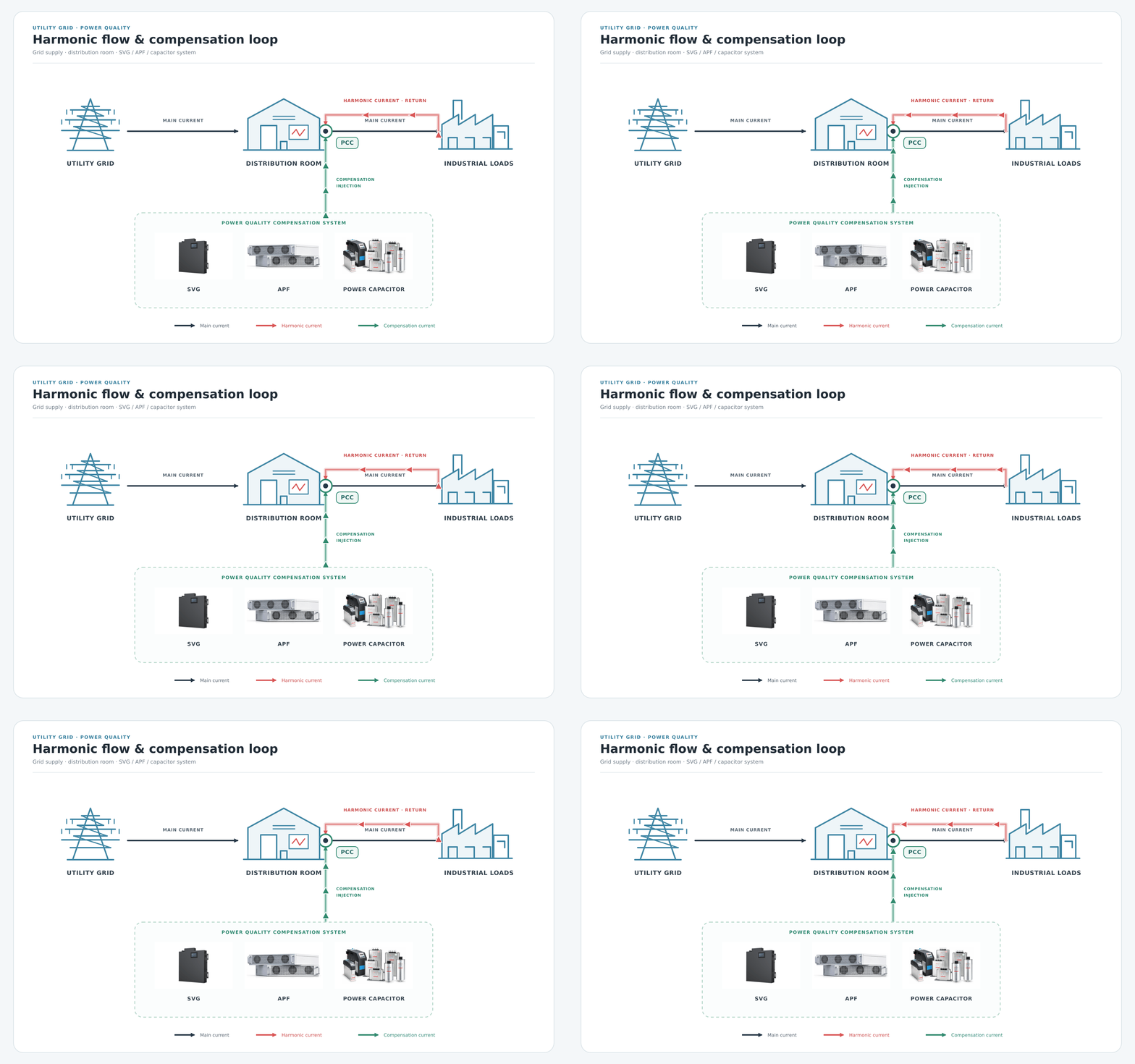
The right solution depends on the actual problem in your electrical system. AHF is mainly used for harmonic mitigation, SVG for dynamic reactive power compensation, and capacitor-based solutions for conventional power factor correction. If several power quality problems occur at the same time, a combined solution may be more suitable.
Yes. An SVG can dynamically provide either capacitive or inductive reactive current according to the real-time condition of the electrical system.
SVG capacity should be based on maximum reactive power demand, load variation, target power factor, three-phase imbalance, and expected future load growth.
Yes. Fast-changing loads are one of the main applications for SVG systems because they can adjust compensation dynamically as the load changes.
Yes. In some PV installations, active power imported from the grid decreases while reactive power demand remains, which can result in a low power factor at the utility metering point. An SVG can provide dynamic reactive power compensation in such applications.
Depending on the configuration, an SVG can provide three-phase imbalance compensation in addition to reactive power compensation.
Yes. Hybrid systems combining SVG and capacitor compensation are commonly used when both fast response and economical bulk compensation are required.
Yes. Modular systems allow additional SVG modules to be added when electrical loads or reactive power demand increase.