Integrated Compensation Unit
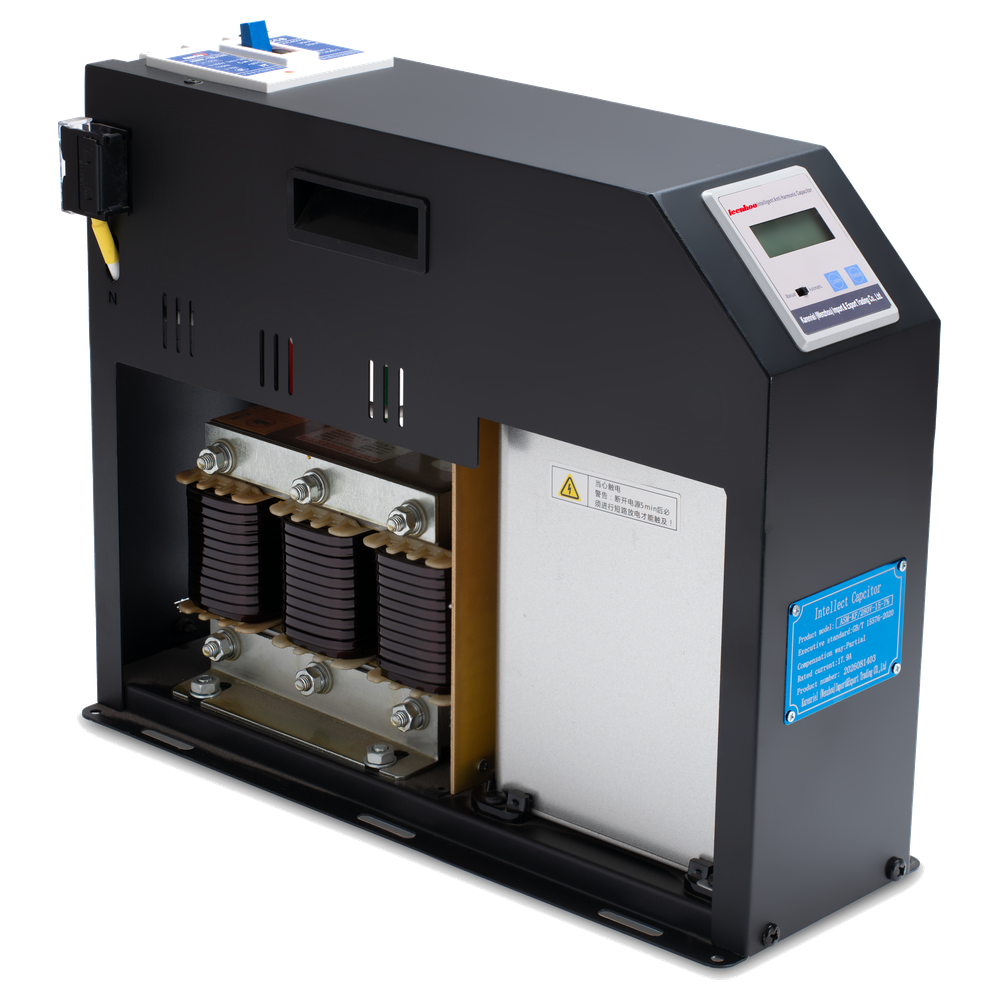
Combines networking, fault monitoring, protection, power capacitors and circuit breakers in one compact compensation unit.

0.4 kV Systems
Anti-Harmonic Intelligent Capacitors
A compact intelligent compensation unit for static reactive power compensation in 0.4 kV power systems.
Product Advantages
Combines networking, fault monitoring, protection, power capacitors and circuit breakers in one compact compensation unit.
Supports three-phase individual compensation, three-phase group compensation and hybrid compensation to suit different system requirements.
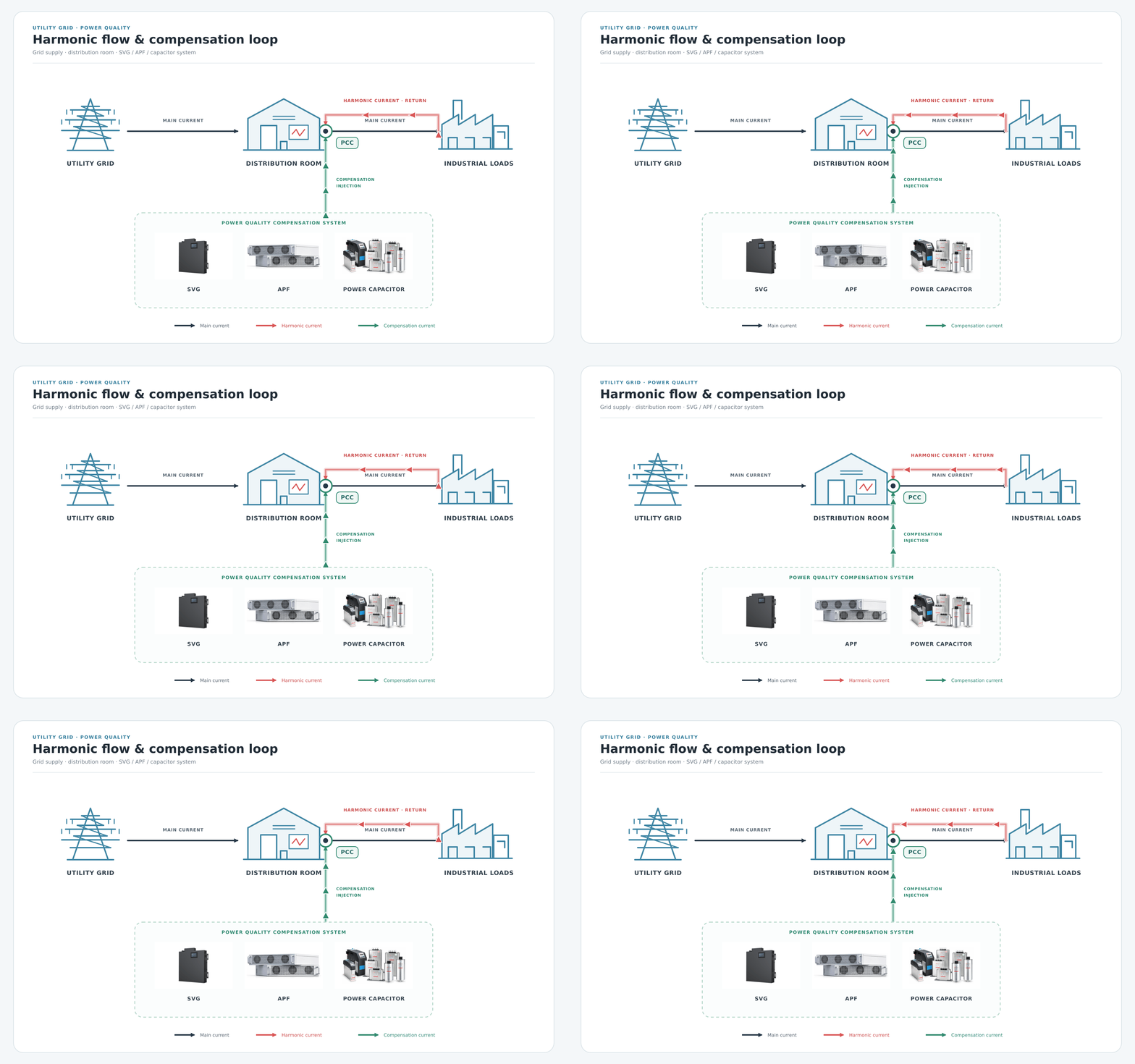
Combines networking, fault monitoring, protection, power capacitors and circuit breakers in one compact compensation unit.
Each unit can operate as a complete reactive power compensation system, supporting power factor improvement and better use of transformer capacity.
No control parameter configuration is required before startup, making installation and operation straightforward.
Supports three-phase individual compensation, three-phase group compensation and hybrid compensation to suit different system requirements.
VFD-driven motors and other nonlinear loads that need reactive compensation with harmonic protection
HVAC, lighting and elevator loads on 0.4 kV distribution systems
Rapidly changing reactive demand and harmonic-rich welding loads
Pump and blower motor compensation in municipal and industrial plants
Auxiliary 0.4 kV systems where power factor and equipment protection matter
UPS and PDU rooms needing compact, networked reactive compensation
Lighting, HVAC and public-service loads with variable occupancy
Continuous motor-driven lines with fluctuating reactive power
Welding, painting and assembly equipment on low-voltage feeders
Pumping stations, street-lighting cabinets and public buildings
| System Working Voltage | Grid Frequency | Voltage Distortion | Sampling Current |
|---|---|---|---|
| 400 V ±20% | 50 Hz / 60 Hz ±5 Hz | ≤5.0% | 100 mA-5 A |
| Voltage and Current Accuracy | Active and Reactive Power Accuracy | Power Factor Accuracy | Communication Protocol |
|---|---|---|---|
| ≤0.5% | ≤1.5% | ≤1% | Modbus RTU / DL/T645 |
| Control Mode | Control Quantity | Compensation Options |
|---|---|---|
| RJ45-6P6C network communication | 32 units | Three-phase individual / group / hybrid |
Common Specifications
Protection: overvoltage, undervoltage, undercurrent, overtemperature and harmonic over-limit protection.
Standard: GB/T15576-2020. Designed primarily for static reactive power compensation in 0.4 kV systems.
| Ambient Temperature | Relative Humidity | Altitude |
|---|---|---|
| -45°C to +55°C | ≤20% RH at 40°C · ≤90% RH at 20°C | ≤2000 m |
Common Specifications
No harmful gases or vapors, conductive or explosive dust, or severe mechanical vibration.
| Ordering Model | Compensation Method | Capacitor Rated Voltage (V) | Rated Reactive Power (kvar) | Dimensions L × D × H (mm) | D1 (mm) |
|---|---|---|---|---|---|
| NHZNKO.48-5-7 | Co-compensation | 480 | 5 | 450 × 165 × 350 | 145 |
| NHZNKO.48-10-7 | Co-compensation | 480 | 10 | 450 × 165 × 350 | 145 |
| NHZNKO.48-15-7 | Co-compensation | 480 | 15 | 450 × 165 × 350 | 145 |
| NHZNKO.48-20-7 | Co-compensation | 480 | 20 | 450 × 165 × 350 | 145 |
| NHZNKO.48-25-7 | Co-compensation | 480 | 25 | 450 × 165 × 350 | 145 |
| NHZNKO.48-30-7 | Co-compensation | 480 | 30 | 450 × 165 × 350 | 145 |
| NHZNKO.48-40-7 | Co-compensation | 480 | 40 | 450 × 165 × 380 | 145 |
| NHZNKO.48-50-7 | Co-compensation | 480 | 50 | 450 × 165 × 420 | 145 |
| NHZNKF0.28-5-7 | Split compensation | 280 | 5 | 450 × 165 × 350 | 145 |
| NHZNKF0.28-10-7 | Split compensation | 280 | 10 | 450 × 165 × 350 | 145 |
| NHZNKF0.28-15-7 | Split compensation | 280 | 15 | 450 × 165 × 350 | 145 |
| NHZNKF0.28-20-7 | Split compensation | 280 | 20 | 450 × 165 × 350 | 145 |
| NHZNKF0.28-25-7 | Split compensation | 280 | 25 | 450 × 165 × 380 | 145 |
| NHZNKF0.28-30-7 | Split compensation | 280 | 30 | 450 × 165 × 380 | 145 |
| NHZNKO.525-5-14 | Co-compensation | 525 | 5 | 450 × 165 × 350 | 145 |
| NHZNKO.525-10-14 | Co-compensation | 525 | 10 | 450 × 165 × 350 | 145 |
| NHZNKO.525-15-14 | Co-compensation | 525 | 15 | 450 × 165 × 350 | 145 |
| NHZNKO.525-20-14 | Co-compensation | 525 | 20 | 450 × 165 × 350 | 145 |
| NHZNKO.525-25-14 | Co-compensation | 525 | 25 | 450 × 165 × 350 | 145 |
| NHZNKO.525-30-14 | Co-compensation | 525 | 30 | 450 × 165 × 350 | 145 |
| NHZNKO.525-40-14 | Co-compensation | 525 | 40 | 450 × 165 × 420 | 145 |
| NHZNKF0.3-10-14 | Split compensation | 300 | 10 | 450 × 165 × 350 | 145 |
| NHZNKF0.3-15-14 | Split compensation | 300 | 15 | 450 × 165 × 350 | 145 |
| NHZNKF0.3-20-14 | Split compensation | 300 | 20 | 450 × 165 × 350 | 145 |
Common Specifications
Dimensions are shown as L × D × H; D1 is the separate dimension identified in the product drawing.
You can also attach drawings, product photos or test reports, if available.
It combines power capacitors, circuit breakers, networking, fault monitoring and protection in one compensation unit.
Yes. The product introduction states that one unit can form a standalone reactive power compensation system and does not require control-parameter setup before startup. Installation and wiring still need to be checked.
It is primarily intended for static reactive power compensation in 0.4 kV low-voltage systems.
Yes. The model table lists common-compensation and individual-phase models, and the product introduction also describes hybrid compensation arrangements.
No. The site’s harmonic conditions need to be checked against the selected model. The product introduction lists a voltage-distortion condition of ≤5.0% but does not give a guaranteed harmonic-reduction result.
Please provide the system voltage and frequency, required compensation capacity, compensation arrangement and any available harmonic measurements.