SiC Ultra-High Efficiency
Empowering Global Industrial Intelligent Manufacturing!

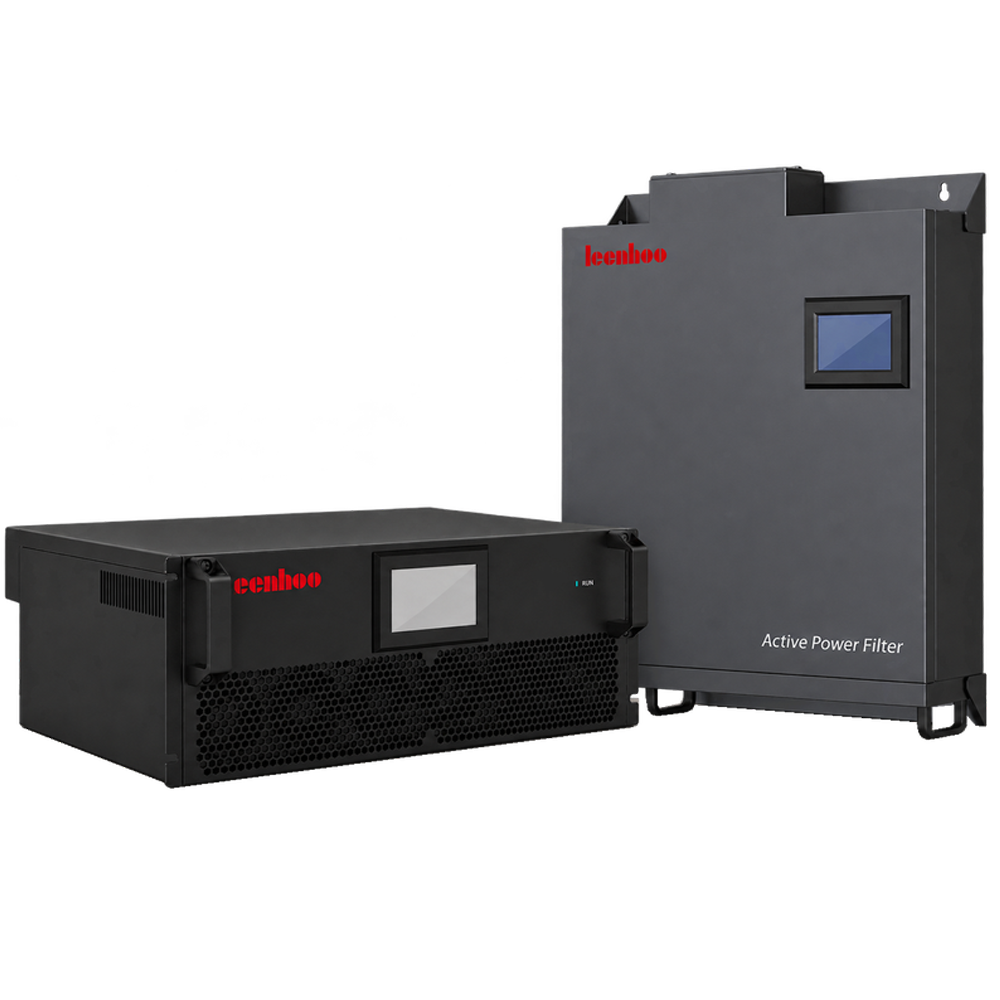
Active Harmonic Filter
Active Harmonic Filter
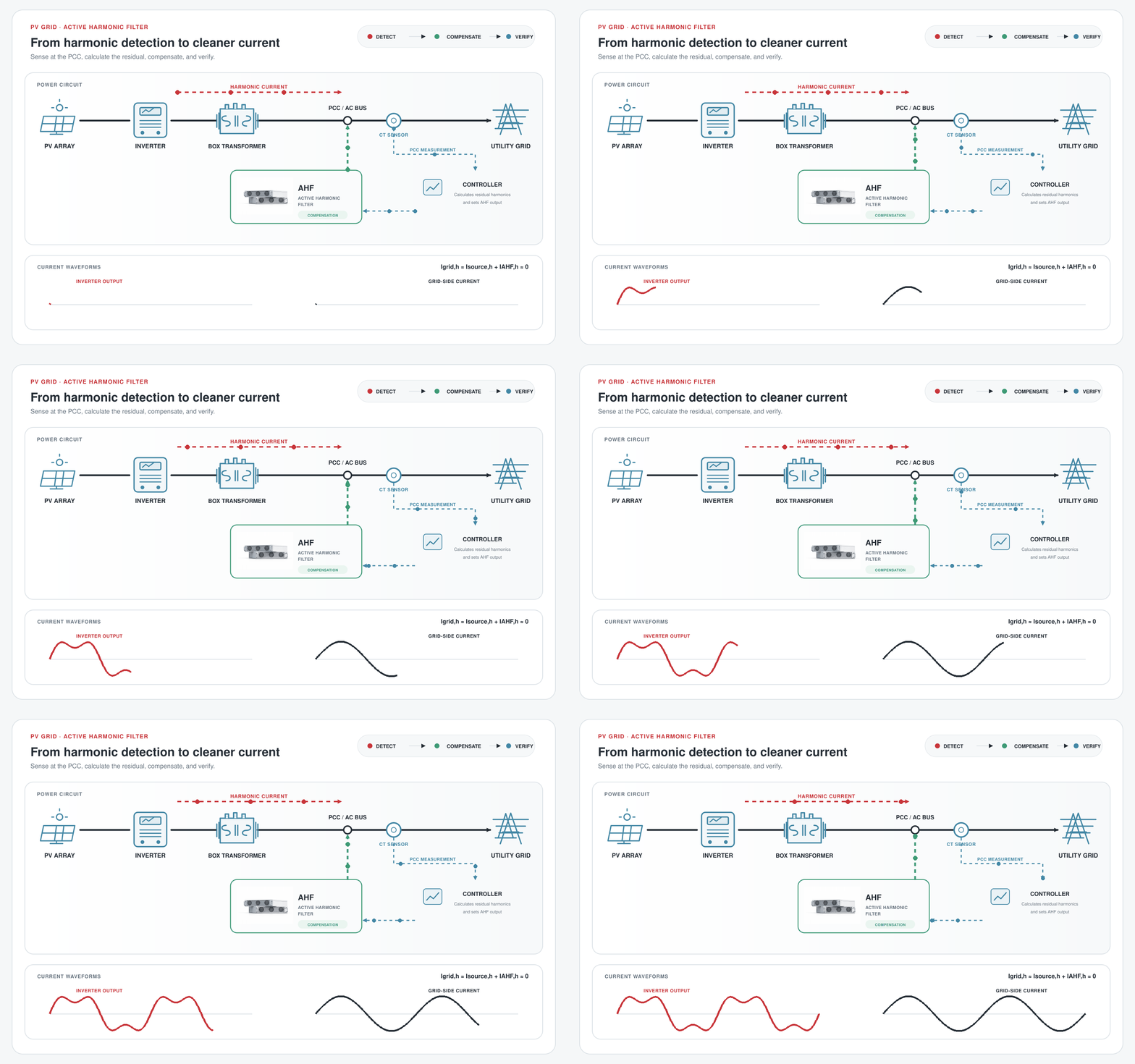
A modular SiC platform that measures nonlinear load current and injects an inverse harmonic current in real time.
Product Advantages
An active harmonic filter (AHF) cancels harmonic currents injected by non-linear loadssuch as VFDs, UPS systems and rectifiers.
Wide-bandgap SiC MOSFETs enable higherswitching frequency, lower losses and a compact thermal design.
This SiC AHF combinesthese advantages with intelligent closed-loop control for demanding power-quality applications.
Wide bandgap, lower on-state resistance, faster switching, reduced switching losses - the physics behind >99% efficiency.
Less input power is converted into waste heat.
Lower thermal load simplifies system heat management
Operating savings accumulate over long duty cycles.
Empowering Global Industrial Intelligent Manufacturing!
>97% Compensation / Up to 95 kHz
Up to 1200A per Cabinet
Up to 1200A per Cabinet
Wall-adjacent installation with scalable capacity
Closed-loop adjustment minimizes manual commissioning.
Resonance suppression, THDu mitigation and hybrid PQ operation.
Improved resistance to corrosive gas and conductive dust.
UPS & server SMPS harmonics
Precision equipment, THDv sensitive
Welding robots, rectifiers
Arc & induction furnaces
Pumps driven by VFDS
LED lighting,HVAC, UPS
Imaging & life-support loads
Traction & signalling
Inverters & grid interface
Drilling & process drives
| Rated Current | Installation | Rated Voltage | Dimensions / Weight | Highlights |
|---|---|---|---|---|
| 5 / 10 / 15 A / Ultra-slim APF | Rack / wall-mounted | 380 V / -40% / +20% | 410 × 315 × 45 mm / 5.0 kg | >97% efficiency · 2nd-61st harmonics / 50 kHz switching · Wi-Fi monitoring / Compact 1U design for point-of-load filtering |
| 25 / 35 A | Rack / wall-mounted / Cabinet integration | 380 / 400 / 415 V | 500 × 470 × 88 mm / 24 kg | 99% efficiency · 2nd-50th harmonics / Compensation rate >97% · Ethernet / TCP/IP |
| 50 / 60 A | Rack / wall-mounted / Cabinet integration | 380 / 400 / 415 V | 500 × 470 × 88 mm / 24 kg | 99% efficiency · 2nd-50th harmonics / Compensation rate >97% · Ethernet / TCP/IP |
| 75 A | Rack / wall-mounted / Cabinet integration | 380 / 400 / 415 V | 500 × 470 × 88 mm / 24 kg | 99% efficiency · 2nd-50th harmonics / Compensation rate >97% · Ethernet / TCP/IP |
| 100 A | Rack / wall-mounted / Cabinet integration | 380 / 400 / 415 V | 500 × 520 × 88 mm / 25 kg | 99% efficiency · 2nd-50th harmonics / Compensation rate >97% · Ethernet / TCP/IP |
| 150 A | Rack / wall-mounted / Cabinet integration | 380 / 400 / 415 V | 500 × 520 × 100 mm / 32 kg | 99% efficiency · 2nd-50th harmonics / Compensation rate >97% · Ethernet / TCP/IP |
| 300 A | Rack / wall-mounted / Cabinet integration | 380 / 400 / 415 V | 500 × 646 × 220 mm / 63 kg | 98.5% efficiency · 2nd-50th harmonics / Compensation rate >97% · Ethernet / TCP/IP |
Common Specifications
50 / 60 Hz · 3-phase, 3-wire or 4-wire · Fast response <50 µs · Full response <5 ms RS485 / Modbus · Unlimited parallel operation · Dimensions shown as W × D × H
You can also attach drawings, product photos or test reports, if available.
An Active Harmonic Filter is mainly used to reduce harmonic currents generated by nonlinear loads such as:
1.Variable Frequency Drives
2.UPS systems
3.Rectifiers
4.EV chargers
5.Welding equipment
6.Data center power supplies
7.Industrial automation equipment
Depending on the configuration, it can also compensate reactive power and three-phase current imbalance.
AHF capacity should not be selected only according to transformer size or total load current.
The required compensation current depends mainly on:
1.Harmonic current magnitude
2.Harmonic spectrum
3.Load variation
4.Target THDi
5.Reactive power demand
6.Three-phase imbalance
7.Future load expansion
For more accurate sizing, harmonic measurement data from the site is recommended.
No practical harmonic filtering system should be expected to reduce harmonics to absolute zero.
The achievable result depends on system impedance, harmonic spectrum, load variation, installation location, filter capacity, and background voltage distortion.
A properly sized AHF can significantly reduce harmonic current and help the electrical system meet the required power quality target.
FUWEI active harmonic filtering solutions can compensate a wide harmonic range, including the 2nd to 61st harmonic orders.
The required harmonic orders can be selected according to the actual load characteristics and site requirements.
Yes.
In applications where certain harmonic orders are more significant, the system can prioritize selected harmonics rather than applying the same compensation strategy to every harmonic order.
This helps make better use of the available compensation capacity.
If harmonic demand exceeds the available compensation capacity, the AHF will operate within its rated capacity rather than provide unlimited compensation.
For sites with large or expanding loads, additional modules can be installed to increase total compensation capacity.
This is why sufficient design margin is recommended during initial sizing.
Yes.
Modular AHF systems can be connected in parallel to increase compensation capacity.
FUWEI solutions support module ratings from 25 A to 300 A, allowing capacity to be configured according to different applications and expanded as site demand increases.
An AHF can operate in systems that already contain capacitor banks, but the complete electrical system should be evaluated before installation.
Particular attention should be paid to:
1.Resonance risk
2.Capacitor switching
3.Reactor configuration
4.Harmonic levels
5.Existing compensation logic
For systems with significant harmonic distortion, conventional capacitor banks may require detuned reactors or a different compensation strategy.